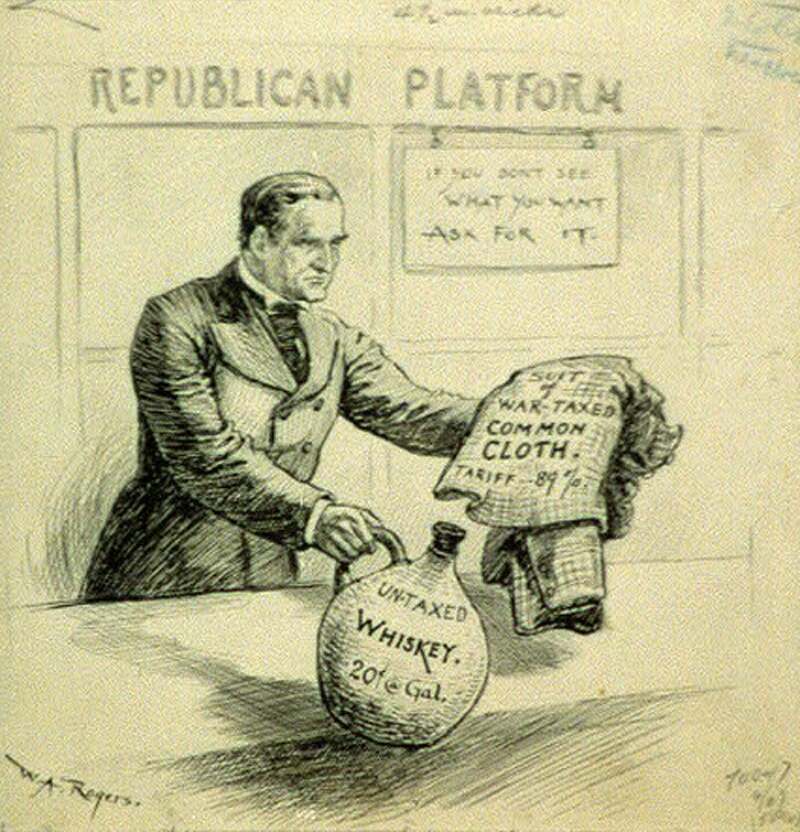
The McKinley Tariff, Harper’s Weekly, July 7, 1888.
Last Friday, the Supreme Court struck down President Trump’s sweeping IEEPA tariffs in Learning Resources, Inc. v. Trump, ruling 6-3 that the International Emergency Economic Powers Act does not give the president the power to impose tariffs. The taxing power belongs to Congress. The Court left refund mechanics to future proceedings, and as Justice Barrett noted during oral arguments, “it seems like it could be a mess.” She’s right. For importers, it will be. Thousands of companies, tens of billions of dollars, a customs system never designed to process refunds at that scale. What’s next for the USTR’s ship tax, and how will owners seek refund?
The USTR’s Section 301 maritime service fees—targeting Chinese-built, Chinese-owned, and Chinese-operated vessels—were suspended on November 10, 2025, weeks after they took effect, as leverage for the Trump-Xi trade deal. But the underlying Section 301 determination remains legally intact. The threat has not disappeared. It has been deferred.
This matters because the constitutional deficiencies the Supreme Court identified in the IEEPA tariffs apply with equal—arguably greater—force to the Section 301 fees. Chief Justice Roberts wrote that IEEPA “contains no reference to tariffs or duties” and that “no President has read IEEPA to confer such power” before this administration. The Section 301 fees suffer from the same infirmity—and an additional one. They are neither a proper tariff nor a proper tonnage duty. They have no home in American law.
The matter strikes at the very heart of the constitutional design. Customs receipts—from cargo duties and vessel tonnage taxes together—constituted eighty to ninety percent of all federal revenue through the early industrial revolution. Until the Sixteenth Amendment authorized the income tax in 1913, the customs house was the United States Treasury. The first Act of the First Congress was a tariff bill. The second was the Collection Act that created the Customs Service and designated ports of entry. The framers separated cargo duties from vessel charges—Article I, Section 8 for the former; Article I, Section 10 for the latter—with the precision of men who understood that control of port revenue meant control of national solvency. The Supreme Court has enforced this divide for over 150 years. To President Trump’s credit, the instinct to treat trade as a matter of national solvency and security is not wrong, nor new. It is just that the manner in which the administration has approached the matter is not right.
The Section 301 fees shatter this framework. They are triggered by vessel characteristics—Chinese build, Chinese ownership, Chinese charter—but assessed per TEU, per CEU, or per net ton of cargo capacity. They are a charge on the ship dressed up as a charge on the cargo. Decades of customs procedure and law do not support this construct.
· · ·
Which brings us to the express line.
Since the founding, the United States has maintained an administrative process for resolving disputes between vessel masters and the government over dues, fines, forfeitures, and penalties. Different from an importer’s protest, carrier procedures are designed to move at the speed and character of international carriage of goods. The historical precedent for this is not abstract or novel.
Justice Story cemented the principle in United States v. The Brig Malek Adhel (1844): “The vessel acts and speaks by the master. She reports herself by the master.” The brig’s master had committed offenses on the high seas without the owners’ knowledge, yet the vessel herself was held liable in rem—because in admiralty, the ship is the instrument. That same principle works in reverse: when the government imposes an unlawful charge, the master has standing to challenge it.
In Cannon v. New Orleans (1874), the owner of the steamboat R.E. Lee paid a per-ton levee due under protest, then sued for a refund. The Supreme Court struck it down as a tonnage duty: a charge measured by the capacity of the vessel, claimed for the privilege of arriving and departing a U.S. port. Two years later, in Inman Steamship Co. v. Tinker (1876), the Court struck down New York’s per-ton port fee on the same grounds. The pattern is unmistakable: vessel interests challenge improper port charges, and the Constitution vindicates them.
Consider light money—the longstanding duty imposed on every foreign vessel entering a U.S. port, assessed by a characteristic of the vessel: her flag. The system already distinguishes between nations: vessels of countries granting reciprocal treatment to American ships are exempt. Over a hundred nations qualify. The People’s Republic of China is on the list.
If the government wanted to impose a discriminatory vessel charge on Chinese shipping, the tools were already in hand. The President can suspend tonnage exemptions for nations that discriminate against U.S. vessels—a graduated framework that has existed since the nineteenth century. OFAC could designate specific companies and individual vessels by IMO number, as it did when it sanctioned Sovcomflot and named fourteen Russian crude tankers during the Ukraine invasion. The government chose none of these instruments.
The refund process for vessel overcharges is straightforward: master files through the agent, port director verifies the facts, appeals go to the Commissioner of Customs and then to the Court of International Trade. This is the same process vessel agents use on behalf of masters and owners every day, in every port. The machinery was built for exactly this kind of dispute.
And it is not dormant. For decades, CBP Headquarters has issued rulings on whether items aboard a ship are vessel equipment or merchandise subject to duty—a distinction tracing to 24 Cords of Cordage v. United States (1857). In 2017, CBP proposed revoking twenty-six such rulings to narrow the definition. The International Marine Contractors Association called it “an inexcusable departure from the essential requirement of reasoned decision making.” By 2019, CBP had partially retreated.
Under the Customs informed compliance framework, vessel owners have a clear pathway to challenge the Section 301 fees. The Headquarters ruling request allows “any person” to request a ruling on “any Customs transaction.” Describe the transaction: a Chinese-built vessel carrying cargo enters a U.S. port. Ask the questions: What is the legal authority for this fee? Is it a tariff or a tonnage duty? If it is a cargo charge, how does the vessel’s country of build affect the classification of the cargo? If it is a vessel charge, where is the Congressional authorization required by Article I, Section 10? Who is liable—the owner, the charterer, or the importer? Where has the Office of Management and Budget allocated the funds? What account receives the money?
Customs Headquarters will struggle to answer without exposing the legal void. The existing vessel charge framework has been formally amended eight times since 1963, each requiring notice-and-comment rulemaking. CBP’s September 2025 tonnage tax modernization—which did nothing more than align the tonnage year to the fiscal calendar and replace paper receipts with electronic ones—produced a thirteen-page Federal Register filing, a sixty-day comment period, an APA analysis, Executive Order review, a Regulatory Flexibility Act analysis, and a ten-year cost-benefit study. The estimated annual impact: $24,792. The $397 commercial vessel user fee required an Act of Congress—the Consolidated Omnibus Budget Reconciliation Act of 1985. That is the infrastructure customs law demands to modify how a two-cent-per-ton tax is receipted, or to create a new fee of four hundred dollars. The Section 301 vessel fees, which could run into the millions per call, have none of it. No authorizing statute. No implementing regulation. No trust fund. No OMB control number. No collection form. No mitigation guidelines. No pathway for petition of remission.
· · ·
The Learning Resources ruling was a restatement of first principles. The same principles that doomed the IEEPA tariffs—lack of statutory authorization, absence of Congressional delegation, no historical precedent—apply with even greater force to the Section 301 vessel fees, which additionally violate the Tonnage Clause and the administrative procedures that have governed vessel charges since the founding.
Unlike the “mess” Justice Barrett foresaw for IEEPA refunds, the vessel-side process is clean. Master files through agent. Port director responds. Headquarters rules. Court reviews. Each case is an individual voyage-based transaction, discrete and manageable.
· · ·
P&I clubs have spent the past year analyzing charterparty allocation. Law firms have published dozens of client alerts on compliance. BIMCO drafted a model clause. But the fundamental challenge—whether the fees are lawful at all, and what the established process is for contesting them—has received remarkably little attention.
The problem is not going away. The Section 122 tariff that took effect on February 24—the ten percent temporary import surcharge—is a cargo tariff that runs through existing customs entry machinery. But the Maritime Action Plan released on February 13 proposes something different: a “universal fee” of one to twenty-five cents per kilogram on cargo arriving aboard foreign-built vessels. That is the same constitutional hybrid as the Section 301 fees—and if implemented without the rulemaking infrastructure customs law demands, it will face the same deficiencies and the same express line.
Ship owners should not wait for the November 2026 suspension expiration to act. Every vessel that called a U.S. port during the October 14 to November 10, 2025 enforcement window should have a ruling request on file. Every owner with vessels subject to future enforcement should file prospective requests describing the anticipated transaction and asking Customs to identify the legal authority. The process is inexpensive, well-established, and preserves rights that may otherwise expire.
The Supreme Court reminded us last Friday of something the founders understood: the taxing power is too consequential to be exercised by executive improvisation. The Tonnage Clause was written to prevent exactly the kind of ad hoc vessel charge that the Section 301 fees represent.
In a political environment where the President calls those who exercise their legal rights “sleazebags,” caution is rational. But vessel owners should understand the position they hold. The master and the owner occupy a class the American legal system has treated with particular respect since its founding—not as adversaries of the government, but as direct counterparties to it. The vessel reports to the customs house. The master signs the declaration. The owner pays the charge or challenges it. That relationship—sovereign and ship, face to face at the water’s edge—is older than the Constitution and embedded in it. It is not a privilege that needs to be asked for. It is a standing that exists by operation of law. The principles of maritime law were ancient when the Constitution was young. They have outlived empires. They will outlive these fees.